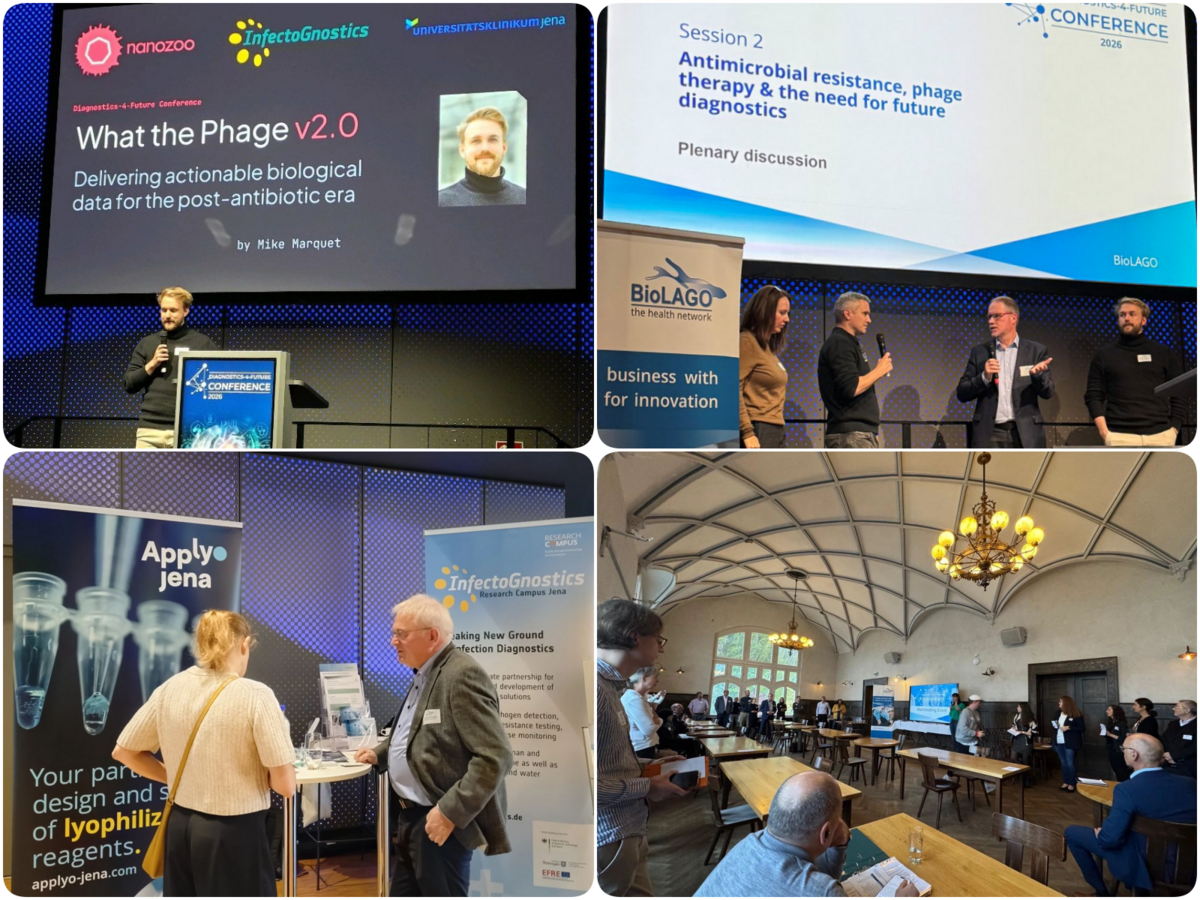
On October 21 and 22, 2026, the Diagnostics-4-Future Conference took place once again in Konstanz. Organized by BioLAGO, the conference focuses on new developments in diagnostics and their implementation in medical practices and hospitals. InfectoGnostics once again supported the partner network by serving on the program advisory board and organizing a joint session. Led by InfectoGnostics manager Dr. Jens Hellwage, the session focused on antibiotic-resistant bacterial infections, phage therapy, and the requirements for future diagnostic procedures. Dr. Shawna McCallin from Balgrist University Hospital highlighted the potential of phage-based therapies; Hendrik Koliwer-Brandl from the University of Zurich addressed susceptibility testing to assess their therapeutic efficacy.
What the Phage 2.0: Making Sequence Data Usable for Phage Research
From the Research Campus, Mike Marquet (Jena University Hospital and nanozoo GmbH) presented the open-source bioinformatics software “What the Phage 2.0.” In his presentation “Delivering Actionable Biological Data for the Post-Antibiotic Era,” he introduced the enhanced software for characterizing bacteriophages. This “toolkit” of various bioinformatics tools allows for the identification of potentially suitable phages and their characterization for further investigation.
While the original version was primarily focused on identifying phages in sequence data, What the Phage 2.0 significantly expands the scope of analysis: The workflow combines various bioinformatics tools for annotating phage genomes, for taxonomic classification, and for predicting potential bacterial hosts and the phages’ modes of life. In addition, it detects prophages—that is, phage sequences integrated into bacterial genomes. The combination of multiple analytical methods is intended to mitigate differences between individual programs and enable more robust results. Processed tables and graphical representations facilitate further evaluation. In this way, What the Phage 2.0 supports the preclinical characterization of phages and creates a data foundation for further research approaches.
Partnering, Exhibition and Transfer to Clinical Care
In addition to the conference program, InfectoGnostics was represented at the industry exhibition alongside Applyo Jena and AID Autoimmun Diagnostika. The booths showcased the expertise and solutions offered by the campus network. Applyo Jena contributed its expertise in assay development, freeze-drying, and industrial manufacturing in particular. AID complemented this spectrum with in vitro diagnostics and image analysis systems.
During the partnering sessions on the first day of the conference and also at the exhibition booths, the focus was on networking and identifying potential avenues for collaboration. A staff member from the TransDiag campus project was also on site. Based at Jena University Hospital, the project supports the transfer of diagnostic innovations into medical care—including through clinical needs assessments, assistance with study planning, and advice on regulatory requirements.